Crowd Control: Appeasement, Vanguardism, and the General Strike
:An Analysis from the Twin Cities


In the following analysis, participants in the resistance to Immigration and Customs Enforcement operations in the Twin Cities reflect on the lessons of the strikes of January 23 and January 30, looking for ways to expand and strengthen the movement.
On January 23, 2026, a general strike against the ICE occupation paralyzed the Twin Cities. Seven days later, a second strike took place, on January 30. The first of these mass strikes drew significantly more participants than the second.
A poll conducted by participating labor and faith organizations reports that 23% of registered voters participated in the first strike in some way—a figure that does not even include vast sectors of the working class, such as undocumented workers, young people, and tens of thousands who are understandably disillusioned with the political system. Extrapolating from those polls, which indicated that 38% of those who participated in the strike in some way actively refused to work that day, we can conclude that over 300,000 people withdrew from the economy on January 23 in the Twin Cities alone.
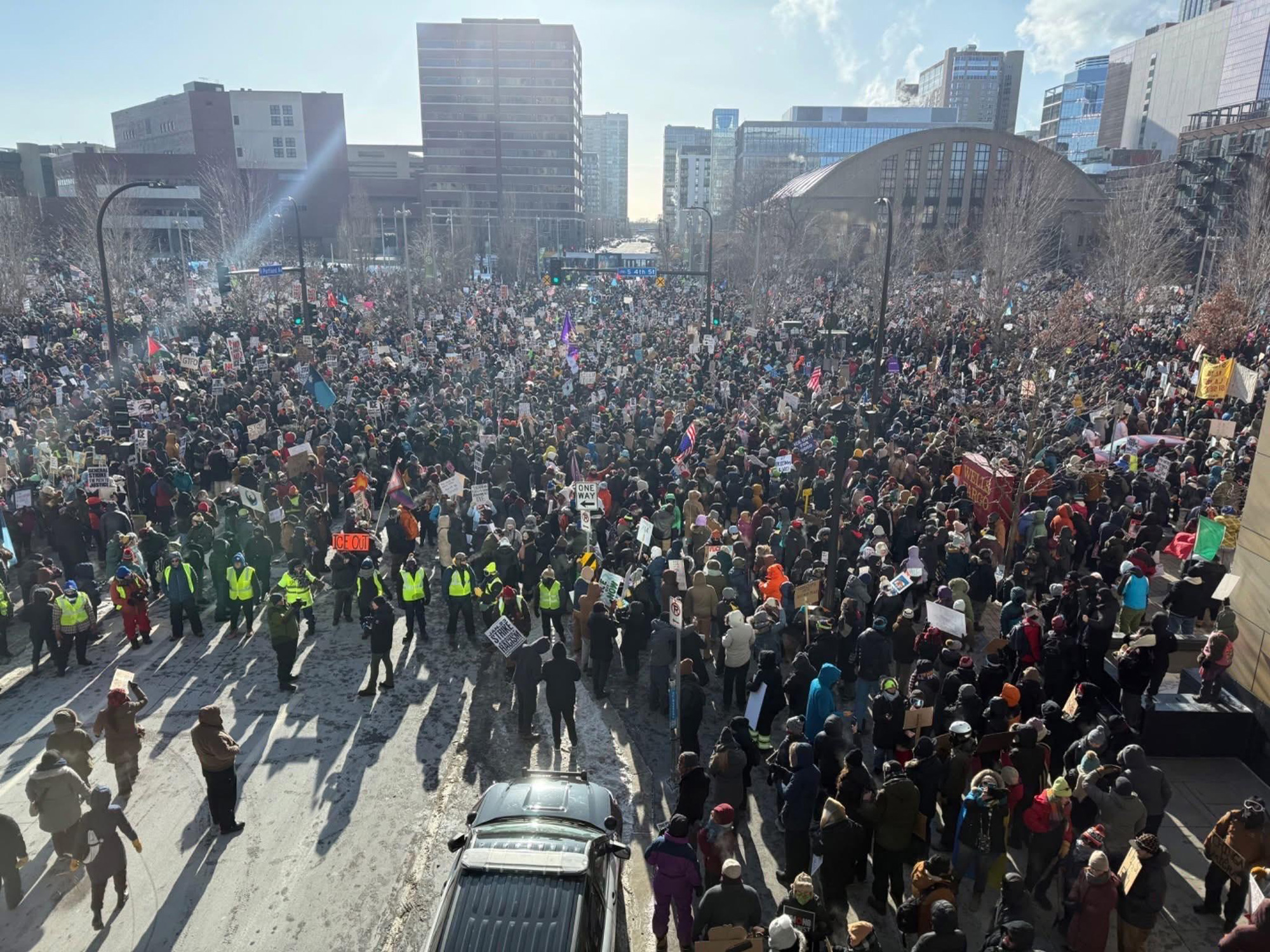
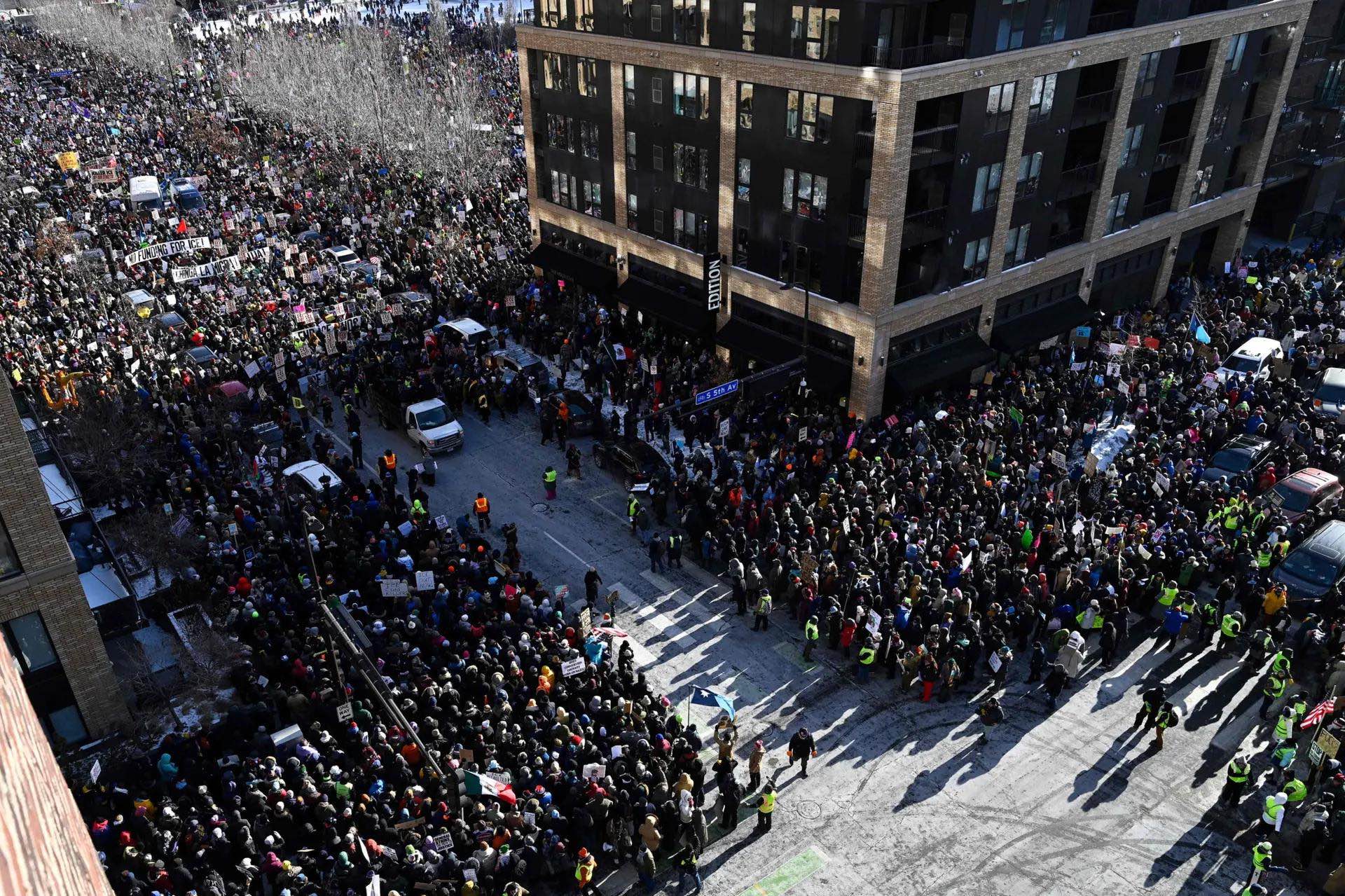
A major Somali shopping center called Karmel Mall closed for the day. Daycare centers were forced to close when their staff demanded the day off. Workers forced a major AT&T call center to close. The biggest nursing home in the Twin Cities metro area held mandatory all-staff meetings to threaten to fire employees who participated, but those scare tactics failed and they faced mass absenteeism. The combined population of Minneapolis and Saint Paul is less than 750,000; that Friday, we saw an estimated 100,000 people take the streets in sub-zero temperatures. It is safe to conclude that at least one out of every eight Twin Cities residents took part in the general strike.
Most of what we have done here since the federal attack on the Twin Cities began has been reactive. We have organized rapid response networks to document ICE and confront their operations; we have driven them out of areas after they shoot or murder people; we have attempted to blockade their headquarters. The really exciting thing about the general strike was that it was proactive: by withdrawing our participation from the economy, we were exerting pressure not only on the Trump regime, but on the capitalist class that backs it and the Democratic politicians who have largely stayed out of its way or actively assisted as its bounty hunters have kidnapped our neighbors and terrorized us.
If we are to reach a future in which we are not at the mercy of a totalitarian police state, we will have to develop our ability to engage in collective actions like the general strike of January 23. We have to become capable of proactively exerting leverage upon our adversaries, fracturing their coalitions and ultimately breaking their grip on power. What could hinder us from doing this?
Appeasement
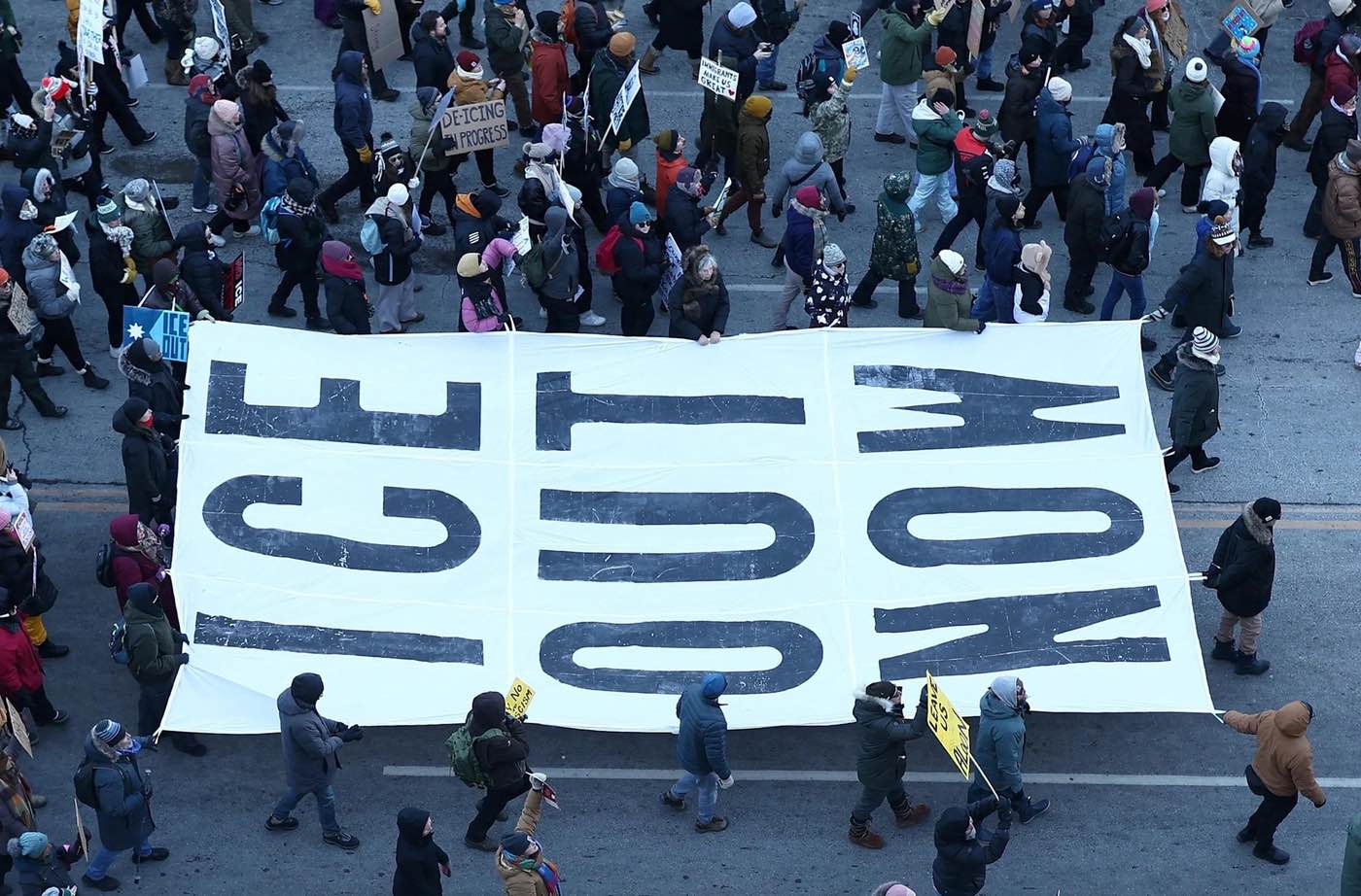
The second general strike was also massive, though significantly smaller than the first. Estimates of the crowd sizes downtown range from 20,000-30,000 people, depending on the source. A number of factors account for this discrepancy in size.
First, the general strike of January 23 had been called at least ten days in advance, whereas the call for the January 30 strike went out only five days ahead of time. But this alone cannot explain the difference. In times of extreme urgency and anger, actions that are called immediately sometimes turn out better than actions that are called too far in advance. The general strike of January 23 occurred at a high point of organically building momentum, when people were desperately looking for a way to take action; the strike of January 30 occurred when politicians had managed to undercut this momentum.
Movements often contract after they appear to have won concessions—in this case, the demotion of Border Patrol “Commander at Large” Greg Bovino and hollow promises from Democrat politicians to negotiate for some “guard rails” around ICE activity. Any apparent victory, however symbolic, functions as a pressure valve to diminish the urgency that people feel.
Although the people of the Twin Cities have experienced horrific violence at the hands of ICE for months now, the replacement of Bovino with border czar Tom Homan has given local politicians an opportunity to assert a new narrative, with governor Tim Walz calling for “a return to normalcy.” At best, this will mean a kinder, gentler Gestapo.
Both Donald Trump and the Minnesota Democrats have a stake in “turning down the temperature,” even if that means that ICE abductions continuing by the thousand. One local Twin Cities group speculates that Walz and Trump are already working together to keep the ICE operation going in a slightly less controversial manner:
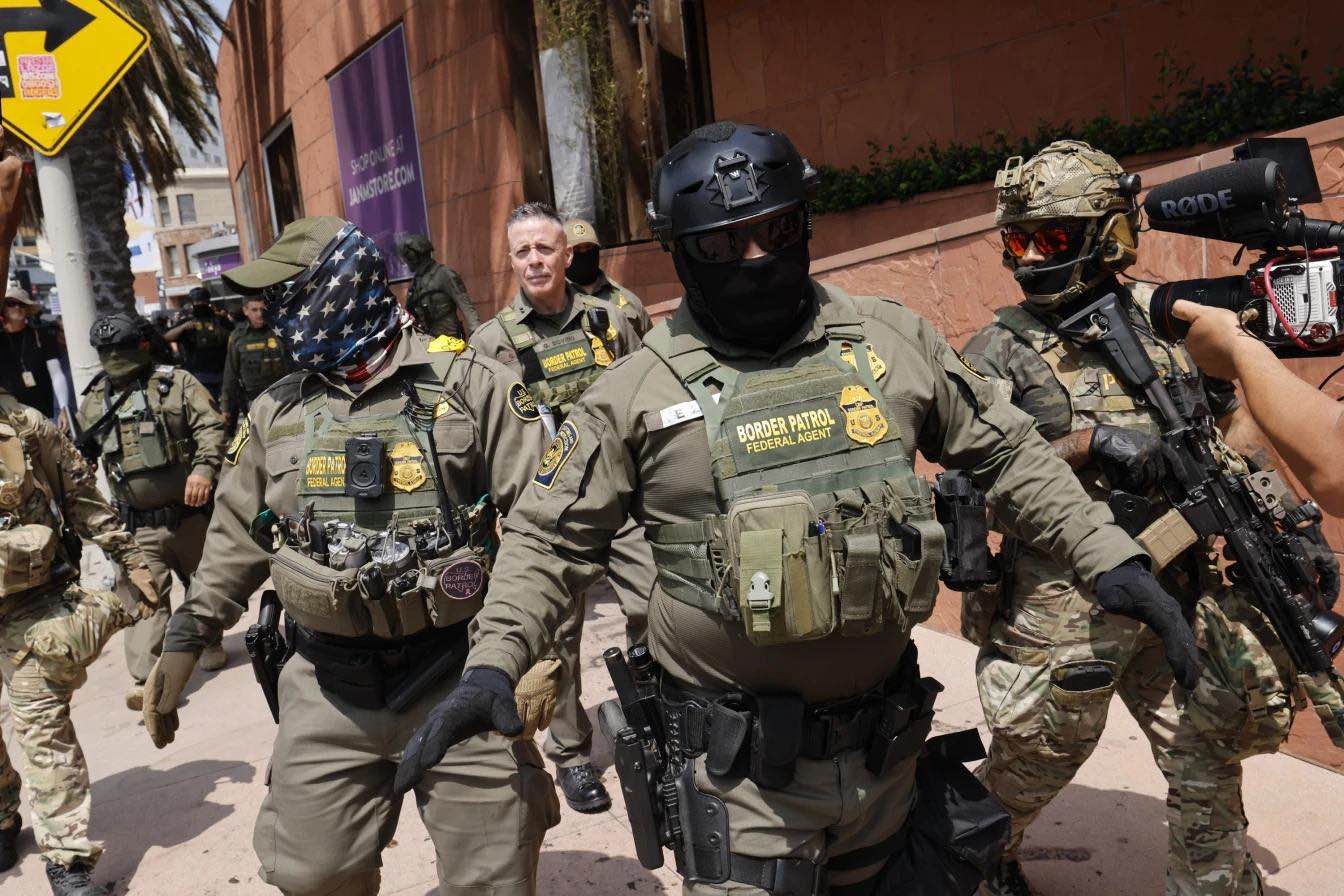
We can infer the nature of the deal Walz made with Trump from the things we have seen over the last six days. Border Patrol have abandoned their previous function as crowd control at ICE’s local headquarters, the Bishop Henry Whipple federal building. Now they have ceded that role to Hennepin County Sheriffs. In the past, we’ve seen these sheriffs wearing standard blue police uniforms. This morning, when they beat and arrested at least five protesters outside Whipple, they were dressed up in tactical gear, green uniforms, and masks. They looked almost indistinguishable from the BorTac officers they are replacing. It seems clear that Walz offered up his own stormtroopers to replace Trump’s, so that Operation Metro Surge can continue unabated, and he can save face by pretending that the worst of the federal invaders have gone home.
Even if the Democrats get ICE to behave more politely, that should appease no one. If all that the Trump administration has to do to normalize putting thousands of ICE agents in the streets is to start by doing so with unhinged violence and then retreat to a slightly less provocative approach, they will repeat that tactic all around the country. There is no “appropriate” role for ICE; Donald Trump has channeled so many billions of dollars to ICE for the purpose of building a private army with which to mete out repression targeting scapegoats and political enemies alike. The road to fascism is paved with reforms that pacify people just long enough to tighten the vice.
Rather than trying to reform institutions that exist for the sole purpose of abducting, oppressing, and murdering, we have to abolish them.
There can be no compromise with institutions that exist for the sole purpose of oppression.
Vanguardism
The other reason that the second strike was smaller was that the constellation of labor unions, immigrants’ rights organizations, and religious institutions that bolstered the numbers for January 23 neither promoted nor mobilized their members for January 30. Instead, the call for the January 30 strike seemed to originate from a coalition of student organizations at the University of Minnesota, including the Somali, Ethiopian, and Eritrean student associations, the Black Student Union, and a graduate student organization.
To understand the political dynamics behind these two very different strikes and the decline in participation on January 30, we have to address an albatross that has weighed down revolutionary movements for centuries: vanguardism.
Vanguardism is defined as
“The strategy whereby an organization attempts to place itself at the center of a revolutionary movement and steer it in a direction consistent with its ideology.”
The idea of a revolutionary vanguard party underpins practically every authoritarian socialist project since the 19th century. In November 1917, Vladimir Lenin made a speech in which he set the blueprint for every state socialist party, asserting that
“A party is the vanguard of a class, and its duty is to lead the masses and not merely to reflect the average political level of the masses.”
Organizations that model themselves in this image see themselves as the brain of the movement, and the rank-and-file participants as the body. They believe that their role is to guide an ignorant populace in a more “advanced” direction.
The anarchist Alfredo Bonanno summarized his critique of this approach succinctly enough:
“This organization tends to cut itself off from and impose itself upon the revolutionary movement that produced it.”
But don’t take Bonanno’s word for it. For us, this is not an ideological issue—a question of political branding—but a strategic issue.
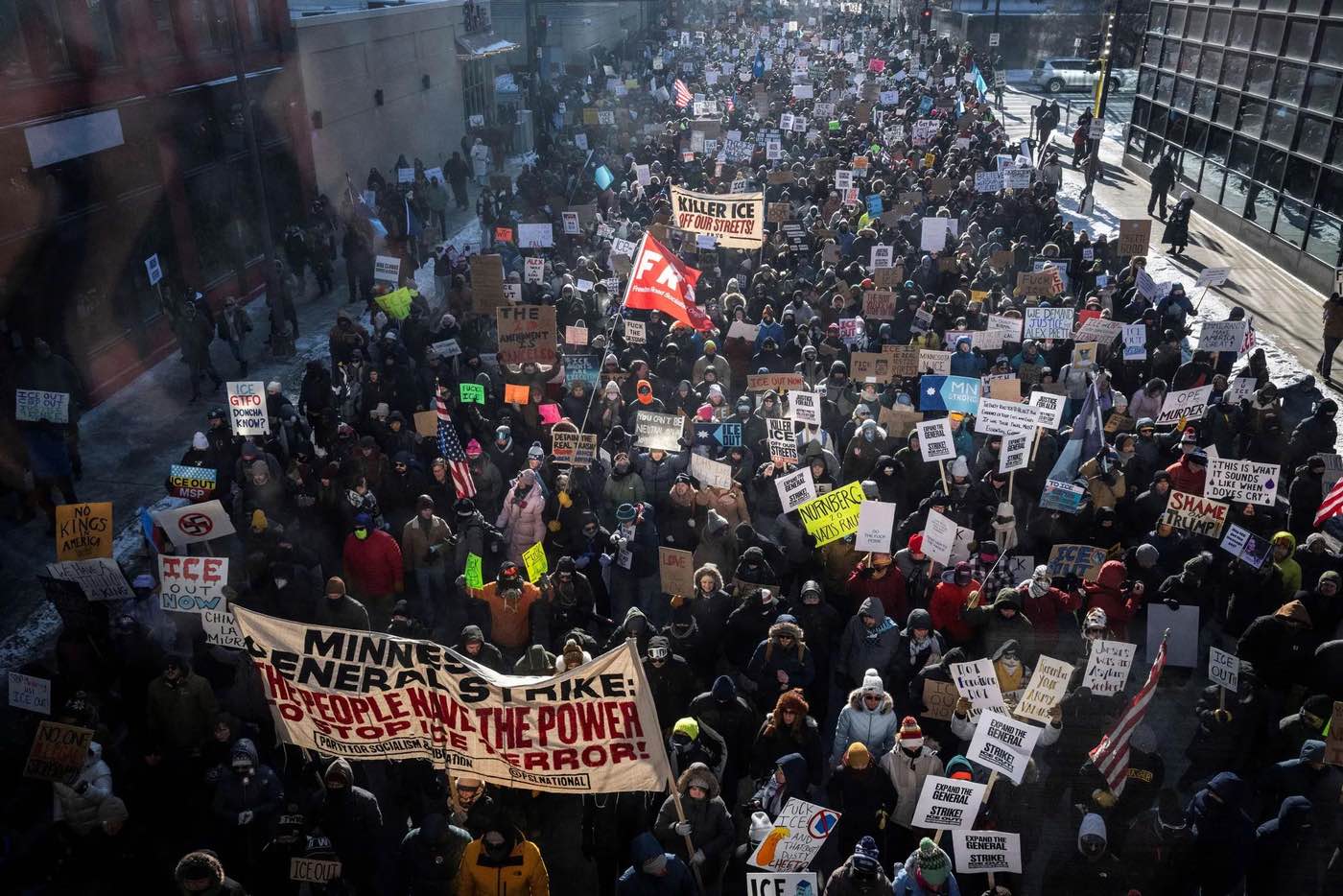
The problem with vanguardism is that even when it works, it doesn’t work. Even when vanguardism consolidates control of a movement in the hands of the leadership of a single organization, it doesn’t make the movement more vibrant and effective. Whether the organization in question uses its authority to impose a direction on the rest of the movement or to hold the movement back from action altogether, it can only inhibit the growth of a movement with a widely distributed sense of agency and initiative. What’s more, organizations that understand themselves as the vanguard of the movement tend to compete with each other for control in ways that undermine the prospects of the movement as a whole. The general strike of January 30 is instructive because it offers examples of all three of these outcomes.
By 2 pm on January 30, it became clear to anyone who was paying attention that the student groups were not themselves in the driver’s seat of the strike. A certain authoritarian socialist party was running the show. Their professionally-printed picket signs displayed their phone number. Their yellow-vested marshals policed the crowd and directed people along a predetermined route. Their chant leaders stood with a PA system on the back of a 26-foot flatbed truck that led the march. We marched in a big circle, starting and ending at the same location, Government Plaza, giving participants no opportunity to engage state forces or gum up ICE infrastructure. Like practically every event that this group has ever called, the march was as much an advertisement for the party as a tactic intended to exert pressure on the ruling class and empower the oppressed.
Presumably, this particular party, fairly large by the standards of Marxist-Leninist sects in the United States but without much of a foothold in the Twin Cities, had funneled its plans through student groups at the university. It used them as proxies to call for a strike at a moment when the iron was hot and the people of Minnesota were clamoring to fight ICE. As vanguard parties frequently do, it led from the rear.
But all was not well in the wider ecosystem of left organizations. Another Marxist party, with a smaller footprint on the national stage but a much more established presence in Minneapolis, refused to participate in the January 30 strike. Through one of its most active front organizations, the Minnesota Immigrant Rights Action Committee, this competing party conspicuously declined to endorse the general strike, explaining this decision thus:
“This is not a MIRAC action. We support the workers’ struggle and follow the lead of unions for strikes and strike related activities. We have not seen the vast majority of unions sign onto this. MIRAC will always put our logo on our events. We do not endorse actions with no organizational logos because we can’t ensure it’s safe [sic] for participants.”
Because this proposal for a mass strike came from outside their turf, they could only view it with territorialism and suspicion. While their competitors led from the rear, this organization sought to stand aside completely, as if they could be neutral on a moving train.
These organizing failures are not merely incidental. They are familiar patterns that have been associated with the vanguardist approach to movement building for generations. The zero-sum approach to politics, the jealous factionalism, the turf war attitude, the reliance on front groups, the deprioritizing of tactics that actually confront the authorities, and the opportunistic drive to seize a leadership role over and above any other strategic consideration are all recognizable signs of vanguardism.
The resistance to ICE in the Twin Cities became powerful because, rather than starting from top-down leadership models, it began at the grassroots with models that anyone could employ, models that maximized the agency and autonomy of everyone who wanted to participate. The rapid response networks proliferated because they were empowering, because they made everyone a protagonist, not because they were controlled by infallible leadership. If anything, the Twin Cities rapid response model removed bottlenecks and centralization from the model developed just a couple months earlier in Chicago, which had already been horizontal and participatory.
Because the movement in the Twin Cities grew up in a process of organic experimentation, offering space for everyone’s ingenuity and initiative and recognizing strength in diversity rather than in the control of a preexisting leadership, it has been able to grow bigger, stronger, and smarter than any single party ever could. People try out tactics and strategies and stick with the ones that work, not the ones that benefit a leadership cadre. We should not conflate building the membership of top-down organizations with building the power of a movement. For example, many unions officially refused to participate in both the January 23 and January 30 strikes, but rank-and-file membership participated in both nonetheless. Rank-and-file readiness to strike is almost always ahead of the leadership, in unions and parties alike.
As long as our movements depend upon vanguardist organizations and their petty power struggles, we will remain at their mercy and consequently at the mercy of the ruling class. We need a movement that cannot be held back or hijacked by any leadership, a movement that compels every aspiring vanguard to hurry after it, setting aside their squabbles and petty ambitions. That was what made the general strike of January 23 so powerful.
So the problem with the January 30 strike was not that it brought out fewer people than the January 23 strike, per se. Many of the experiments that participants in the movement in the Twin Cities have undertaken have brought out far fewer people while pointing to an open horizon and demonstrating possibilities that others could take up and improve upon. But simply attempting to repeat the movement’s previous victories for the sake of recruitment, without opening space for innovation and confrontation, can only run it into the ground.
The important question is whether an organizational model is reproducible, serving to empower whoever makes use of it to resist oppression, or extractive, serving to concentrate power in the hands of leaders.
The leaderless character of the resistance to ICE in Minnesota is precisely what has made it effective. The decentralized nature of the rapid response groups has made them durable and agile. The initiative of autonomous fighters in the neighborhoods has enabled people to rise in revolt every time they have shot or murdered our neighbors. The horizontality of our mutual aid networks makes them opaque to the feds while enabling them to feed, clothe, and care for vulnerable families. No official organization would ever dare to call for the countless acts of bravery by which individuals have collectively propelled this movement forward. The everyday anarchism of the Minneapolis revolution is its greatest strength.
To the extent that we allow top-down forces to take control of the movement, we will compromise its structural integrity and set ourselves up to lose. With so much on the line, we can’t afford to let that happen.
We don’t need everyone who participates in the movement to agree. Some will buy into the false promises of Democratic politicians, at least until the next betrayal. Some will prefer to look to the leadership of authoritarian cadre organizations. But if a critical mass of people understand that no one is coming to save us—that it really is up to us to win this fight—and take it upon ourselves to stand up to ICE, doing whatever it takes regardless of what any politician or party prescribes, our movement will remain dynamic enough to go on growing.
And in the end, we will win.
Further Reading
- The Noise Demonstrations Keeping ICE Agents Awake at Their Hotels—A Model from the Twin Cities
- Minneapolis Responds to the Murder of Alex Pretti: An Eyewitness Account
- Protesters Blockade ICE Headquarters in Fort Snelling, Minnesota: A Report from an Action during the General Strike in the Twin Cities
- From Rapid Response to Revolutionary Social Change: The Potential of the Rapid Response Networks
- Rapid Response Networks in the Twin Cities: A Guide to an Updated Model
- North Minneapolis Chases Out ICE: A Firsthand Account of the Response to Another ICE Shooting
- Minneapolis Responds to ICE Committing Murder: An Account from the Streets
- Protesters Clash with ICE Agents Again in the Twin Cities: A Firsthand Report
- Minneapolis to Feds: “Get the Fuck Out”—How People in the Twin Cities Responded to a Federal Raid